
Becoming a parent may be an tedious road that is full of expectations, anxieties and confusion. Problematic couples tend to pose a question: “Will it work in our case? Some of the most significant indicators include the ICSI Success Rate by the number of times that this specialized fertility procedure results in pregnancy and live birth. In Pacific IVF in Nepal it is the knowledge of ICSI – Intracytoplasmic Sperm Injection – that will help us make informed decisions. This modernized process has redefined the potential of couples who are having problems with conception and this provides accuracy, hope, and clarity in the fine dance of life.
What Is ICSI and How Does it Work?
Summary: ICSI is an accurate IVF method that involves the direct injection of an egg by a single sperm, which has increased fertilization probabilities in particular circumstances.
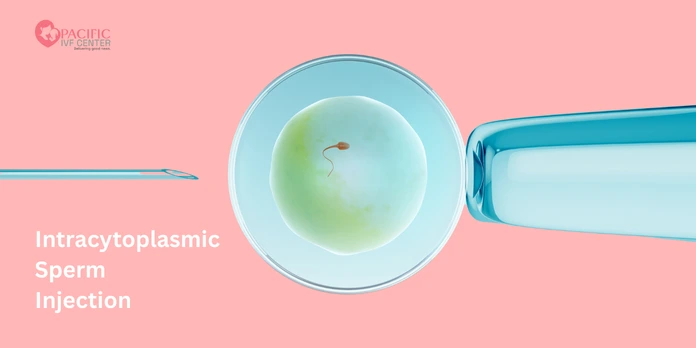
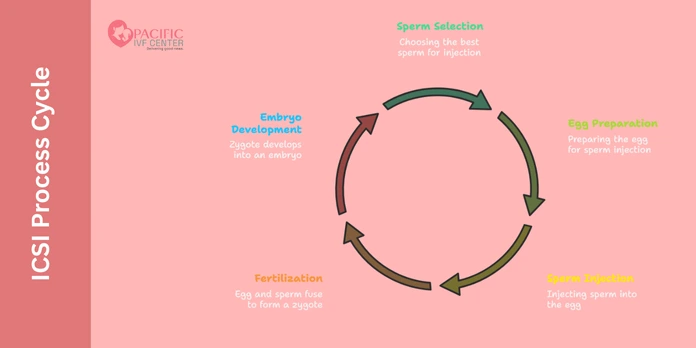
ICSI is no longer a medical practice but a well-planned entertainment of science and time. This involves the extraction of the mature eggs of the female partner using mild sedation to make the process comfortable. Meanwhile, a male partner gives a sperm sample which is processed to get the healthiest cells. An embryologist implants the single sperm in each egg using a very specialized type of needle that is known as a microneedle and this process avoids natural fertilization barriers. Embryologists would observe fertilization over the following 16-18 hours after which embryos are cultured in an optimized lab setting until they are fit to get transferred.
Key distinctions from conventional IVF:
- In normal IVF, a large number of sperms are put around the egg in order to enable natural fertilization.
- ICSI ensures direct fertilization particularly in situations where the sperm count, motility or morphology is degraded.
- ICSI is recommended by doctors when the cause of infertility in males is unknown, it is a result of previous IVF treatment failure, or there is a low fertilization rate.
In pacific IVF, a couple is provided with personalized guidance so that ICSI would be applied where there is a clear benefit, to maximize ICSI Success.
What Is the ICSI Success Rate in the Present?
Gist: The knowledge of benchmarks will assist couples in having reasonable expectations in relation to their fertility process.
There are numerous factors, such as age, health, and expertise in a clinic, which affect the ICSI Success Rate. ICSI has a fertilization success rate of 50-80% all over the world, although not all fertilized eggs lead to a pregnancy. The live birth rate per cycle is usually between 30-50, and it is necessary to highlight the gap between fertilization and a real ICSI Success.
Age-specific success rates:
- Under 35 years: ~40-50%
- 35-37 years: ~36%
- 38-40 years: ~23%
- Above 40 years: ~8-10%
Cumulative chances are enhanced in repeated cycles. Most couples conceive on the second or third attempt which shows the significance of patience and planning.
Factors That Strongly Affect ICSI Success
Gist: There are a number of factors that have an influence, including the biological aspect and everyday life decisions.
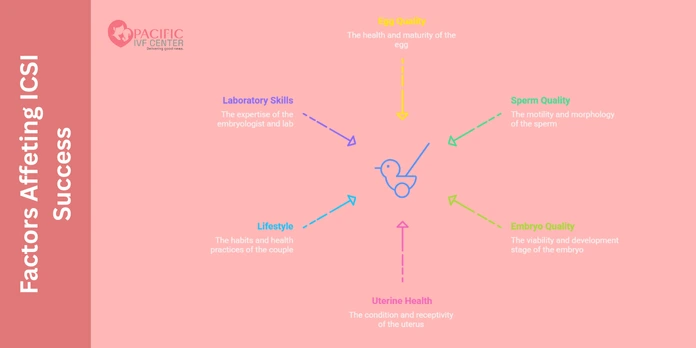
ICSI is not a panacea, but its success may be improved on the condition of knowing the main factors that should be considered:
- Egg quality and age of the female: Women that are younger tend to have a higher success rate because of egg quality.
- Sperm quality: Sperm motility, morphology, or quantity may impair the ability of fertilization and ICSI overcomes the problem.
- Embryo quality: Good implantation chances are made possible with healthy embryos with good cleavage rates and blastocyst formation.
- Uterine: The receptive uterus is necessary to have a successful implantation.
- Lifestyle: Diet, physical activity, stress management, and not smoking or drinking alcohol can enhance results in a subtle manner.
- Laboratory and embryologist skills: The high-level equipment and specialists guarantee the best conditions to the embryos development.
Pacific IVF concentrates on all such factors to establish environment that would maximize the ICSI Success Rate.
Who Benefits the Most From ICSI?
Gist: ICSI is beneficial to a number of people, but more so in addressing some fertility issues.
Ideal candidates include:
- Male-Factor infertile couples.
- Those who have already failed at IVF.
- Cases of low sperm count, mortility or morphology problems.
- The blocked or post vasectomy patients.
At Pacific IVF, they examine cases separately and make sure that they can use ICSI in the cases where it can provide the most benefit.
ICSI vs IVF: Which Has Higher Success Rates?
Gist: The difference assists the couples in making informed decisions.
ICSI and IVF are the complements of assisted reproduction. IVF permits natural fertilization as opposed to ICSI which ensures direct sperm injection into the egg which is a definite advantage when there are cases of male-factor infertility. Live birth rates might not vary in male factor cases, however.
When to consider each:
- IVF: Appropriate when the testicular production of men is normal.
- ICSI: Use when the quality of sperms is low or there is a history of fertilization failure.
Pacific IVF is committed to offer professional advice to enable the couples to choose the approach that will give them the best opportunity and therefore, have individual approach to fertility.
How Many ICSI Cycles Lead to Pregnancy?
Gist: It might be required to do several cycles and the probability of success is cumulative in nature.
There is an intermediate probability of success in the first cycle, and a second cycle is likely to have better results:
- First cycle: approximate probability of live birth =30-35% probability.
- Second cycle: cumulative chance = 50 -55 percent.
- Third cycle: may reach ~60-65%
Pacific IVF helps couples during this process offering their own plans and selective embryos to increase the success of ICSI.
How Pacific IVF Improves ICSI Success Rates
Summary: Knowledge, technology and individual focus directly enhance outcomes at the clinic.
- Advanced laboratory technology also provides the embryos with the most preferable conditions to develop.
- The skillful embryologists carry out the sump injection of sperm and keep a close check on the fertilization.
- Individualized treatment programs take into consideration the medical history of each couple, age, and fertility problems.
- Culture Blastocyst culture permits the selection of the most vigorous embryos to be transferred, which leads to a higher chance of implantation.
This practice contributes greatly to the ICSI Success Rate, and it is the combination of science and care and empathy.
Tips to Improve Your Chances of ICSI Success
Summary: Lifestyle changes are not a substitute of medical care and can be used to enhance the results.
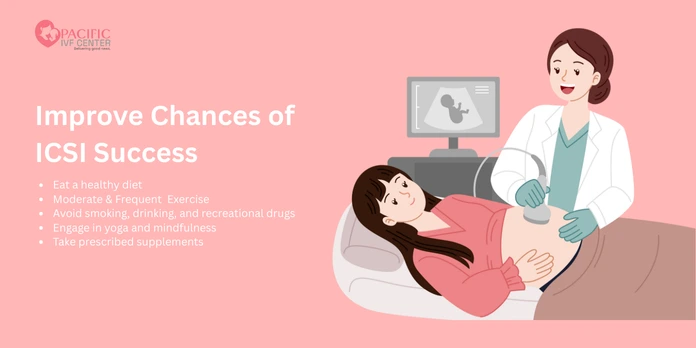
Although medical intervention is crucial, there are small steps that could be used to promote fertility:
- Eat a healthy diet that is full of antioxidants and folate.
- Take moderate and frequent exercise.
- Do not smoke, drink alcohol and recreational drugs.
- Address stress meditatively, yoga or mindfulness.
- Take supplements prescribed by the doctor to promote reproductive health.
ICSI Success can be positively affected even by small and regular attempts.
Common Myths About ICSI Success Rate
Gist: Facts assists the couple to treat the therapy with realistic expectations.
- ICSI is guaranteed to cause pregnancy – Pregnancy is not just achieved through fertilization, implantation and birth of the life are dependent on various factors.
- ICSI is effective in all cases – It is most successful in male-factor infertility or when the IVF treatment has failed previously.
- ICSI, in eliminating all fertility problems – It does not deal with uterine, hormonal, or genetic problems.
In Pacific IVF, the couples are taken through the process with transparent and evidence-based information.
When to Consult an IVF Specialist
Gist: Early intervention may be a way to improve the results and create clarity.
Couples are to seek the assistance of a specialist in case:
- Not conceived in 12 months (or 6 months in case of over 35 years)
- Male-factor infertility problems are known.
- Past on-IVF or ICSI procedures had failed.
- The irregular cycles or reproductive problems that are known.
Pacific IVF makes sure that a careful assessment, individualized advice, and a plan to the Enhancement of the ICSI Success Rate are done.
Final Thoughts: Is ICSI the Right Choice for You?
ICSI is an embodiment of hope, accuracy and a way out of the infertility troubles by couples. The knowledge of the ICSI Success Rate, age, health and clinic quality will enable couples to make the right decisions. Pacific IVF is a blend of technology, expertise and a personalized care designed to achieve maximum output and make the uncertainty of fertility struggles a possibility to get a chance to have a child.
FAQs:
1. Success of ICSI the first time?
The ICSI Success Rate under the first-time cycle has a general range of 30-35 percent in the case of age and factors of fertility. The Pacific IVF guarantees an individual treatment program to increase your success on the first try. Couples in Pacific IVF have a bonus of high lab technology and professional embryologists that boost the overall ICSI Success Rate.
2. Which is the success rate of ICSI in the IVF?
In combination with IVF, the ICSI Success Rate may range between 30 and 50 per cycle with the quality of eggs and sperms. All the IVF cycles at Pacific IVF undergo a close observation in order to have the best possibility of fertilization by using ICSI. Couples who prefer Pacific IVF get special guidance, and their total ICSI Success Rate is enhanced considerably.
3. Is ICSI associated with increased pregnancy?
Yes, ICSI has the potential to enhance fertilization rate, especially in male factor infertility, and that is why it increases the ICSI Success Rate. To be able to introduce a sperm, Pacific IVF employs some of the most accurate and skilled embryologists. With Pacific IVF, couples are helped to undergo a well-organized process, which increases the probability of success.
4. Can ICSI damage the egg?
ICSI is carried out in a high controlled situation so that the risk towards the egg can be minimized making the procedure a safe one that would not compromise on the anticipated ICSI Success Rate. In Pacific IVF, eggs are well preserved by state of art equipment and highly trained personnel. Customers who have confidence in Pacific IVF are assured of the highest level of attention to the eggs, and it improves the overall success rate of ICSI.
