
The starting point of IVF may seem to have opened up the door to a wonderful and unknown world- the world where science touches upon hope. The ivf timeline is not only about counting days but, more importantly, about getting ready to create a journey that will involve both medical accuracy and human feelings. Each of the procedures, including consultation and embryo transfer are carefully planned to provide hopeful parents with the best opportunity to bring life into existence.
This can be done at Pacific IVF Nepal, where special fertility experts help the couple using innovative technology with a caring approach that will make all couples feel supported, educated, and hopeful. It is in this guide that we will reveal the ivf timeline. Each step will be explained in easy, clear, and professional language, and just a little storytelling will also be added to make the course of events relatable.
What Is IVF?
However, before we actually get into the IVF timeline, it is essential to know what IVF actually is. In-vitro fertilization or IVF is the procedure that involves fusing an egg and sperm in a laboratory environment in a specialized laboratory in order to form embryos. Their embryos are then closely observed, and one or more of them are implanted into the uterus, hopefully resulting in a pregnancy.
IVF is an incredible blend of science and technology and human effort. It is also commonly prescribed to those couples experiencing fertility problems, such as ovulation, low sperm count, closed fallopian tubes, or unspecified infertility.
Knowledge of the IVF process forms a basis for knowledge of the ivf timeline since every phase is vital in the success of the process.
Why Understanding the IVF Timeline Matters
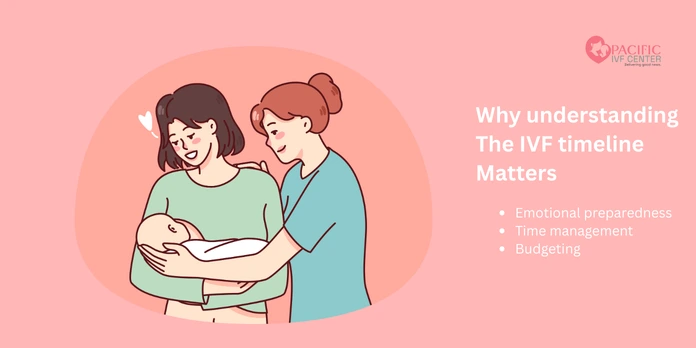
Being aware of the ivf timeline will enable the couples to be prepared emotionally, financially, and physically for the process. It establishes achievable goals, minimizes anxiety, and keeps all appointments, medications, and procedures in line with maximizing success.
- Emotional preparedness: This is knowing what to expect in every step, which lowers the fear and uncertainty.
- Time management: Assists in scheduling work, travel, and personal schedules based on appointments.
- Budgeting: Budgeting and knowledge of costs and phases make it clear and ready.
The complete IVF Timeline (Step-by-Step).
Each IVF process is more like a well-orchestrated drama where each step leads to the next, and the couple gets a step closer to their dream. The following is the use of a step-by-step IVF timeline, in an easily understood and simple manner.
Step 1 – Pre-Cycle Consultation and Testing.
The IVF process starts with an elaborate consultation and set of examinations before the initial injection or scan. At Pacific IVF Nepal, this step gives a chance to examine both partners.
Summary: The basis of a successful and safe IVF adventure is pre-cycle testing.
What Happens:
- Hormone: Test ovarian reserve (AMH, FSH, LH) and thyroid profile.
- Semen analysis: Evaluate the sperm count, motility, and morphology.
- Ultrasounds: The investigation of the ovaries, uterus, and general reproduction.
- History Review: Determine what may influence the outcome of IVF.
Timeframe: 1-4 weeks, based on the timing of the tests and test outcomes.
Why It Is Important: When properly prepared, complications are minimized, the quality of the eggs is maximized, and the treatment planning is individualized.
Step 2 – Ovarian Stimulation (10-14 Days)
Ovarian stimulation is initiated after tests are carried out. The hormonal injections stimulate the ovaries to generate more than one egg, as compared to the one egg that would be developed during a menstrual cycle.
Gist: This step prepares the process of gathering several good eggs, which will have a high possibility of fertilization.
Process Details:
- Overall, daily injections of FSH or other related hormones to induce the ovaries.
- Repeat blood tests and ultrasounds to check the growth of the follicles.
- Individual response dose modifications.
Tips for Patients:
- Keep a good living and eating habit.
- Injections Tracking: Make sure that the timing is right.
- Report any side effects to your specialist.
Time: This IVF timeline may range between 10-14 days, though it depends on the person to respond.
Step 3 – Egg Retrieval Procedure
When the eggs have matured, they will be retrieved. This is an outpatient process that is conducted under mild sedation. The eggs are gathered right out of the ovaries with the help of a fine needle under ultrasound.
Gist: A simple and concise surgical operation, which is essential to extract viable eggs that could be fertilized.
What Patients Can Expect:
- Procedure lasts 10-30 minutes.
- The least amount of discomfort regarding sedation.
- Eggs are immediately forwarded to the laboratory to be fertilized.
Recovery Tips:
- Take a rest for several hours after the procedure.
- Normal mild cramping and spotting.
- Take medicine and participate in activities guided by the specialists.
Fertilization & Embryo Culture (3–6 Days)
Having collected the eggs, the trip passes to one of the most enigmatic and vulnerable stages, fertilization and embryo culture. Each egg is then combined with sperm in the lab, and the embryologists observe the development and division of the embryo. This phase is similar to raising a small seed of life, in which science and hope are united in each microscopic cell.
Gist: The fertilization changes hope into potential life, and the development of the embryos should be paid attention to so that the healthiest ones are chosen.
What Happens:
- Eggs are inseminated by the traditional or ICSI (intracytoplasmic sperm injection) in case of necessity.
- The embryos are monitored for their quality and maturity for 3-6 days.
- Decision on fresh transfer or freezing of fresh decision made in later cycles.
Tips for Patients:
- Faith in the procedure; embryos mature in the hands of the experts.
- Keep yourself positive and relaxed; emotional stress has no impact on lab results.
- Learn that the healthiest embryos only transfer, and this enhances the probabilities of success.
Embryo Transfer
The embryo transfer is not very long and is an outpatient process; however, it is a time of expectation and emotion. A chosen embryo is directly inserted into the uterus with a fine catheter. It is quite painless, and it can be said that many couples can relate to this stage, as it is comparable to a normal gynecological check-up.
Gist: A cautious and accurate step, in which hope is established, which is the conclusion of medical preparation and laboratory attention.
What Patients Can Expect:
- Normally performed without any form of sedation.
- Depending on the age and health condition, it is possible to transfer one or more embryos.
- Most of the activities during everyday life can be resumed soon by patients.
Aftercare Tips:
- Light exercise should be temporary.
- Taking drugs per prescriptions to promote implantation.
- Breathing and being emotionally balanced.
The Two-Week Wait & Pregnancy Test
After the transfer of the embryo, the two-week waiting period lies on the emotional side of the patients. This is the time of silence, hope, expectation, and a bit of nervousness. It is medically imperative since the embryo implants and starts growing, but it is also an emotionally demanding experience for many couples.
Gist: The wait is the form of hope, and then the pregnancy test, in order to prove the first step of the journey.
What to Expect:
- Pregnancy is confirmed by blood tests or home tests that come after 10-14 days.
- Some mild cramping or spotting may take place, and it is normal.
- It is possible to have the emotional support of specialists or counselors.
Tips:
- Be concentrated on soft activities and good thoughts.
- Don’t be stressed or overloaded with research.
- Be frank with your fertility team to mentor.
Variables influencing IVF Timeline.
IVF is an individual process of every couple, and various components may affect the time taken in each procedure. By being aware of these factors, couples can have the right expectations and be ready to expect some changes in their schedule.
Gist: Numerous personal and medical aspects may be applied to the IVF timeline, and successive journeys may occur at their own pace.
Key Factors:
- Patient age: The younger patients will react quicker and have a higher quality of eggs.
- Quality and quantity of eggs: Refers to the duration of stimulation and the duration of retrieval.
- Type of IVF cycle: Fresh vs. frozen cycles. This might slightly change the schedule.
- Genetic testing: Non-obligatory preimplantation genetic testing can prolong the culture of embryos.
- Clinic experience and standards: Competent groups would be able to make the process smoother and safer.
Average IVF Timeline in Nepal
In Pacific IVF Nepal, the average time-period of an IVF cycle- ovarian stimulation to confirmation of pregnancy- is 4-6 weeks. Pretesting and consultations can also incorporate more weeks based on requirements. In case of frozen embryo transfers, it can take up to several months, depending on the scheduling and medical reasons.
Gist: Although each journey is different, a timetabled format assists couples in planning and get confident of their IVF journey.
Additional Notes:
- Several cycles can be required to be successful.
- Localized scheduling is used to make sure that couples in Nepal can be approached.
- Well-trained fertility experts lead each step, contributing to the minimization of stress and maximization of results.
Tips for a Smooth IVF Journey
The medical process is very crucial, but lifestyle and emotional help is a key elements in a favorable IVF experience.
Gist: Comfort, confidence, and experience in the IVF timeline can be enhanced through little, mindful habits and support systems.
Practical Tips:
- Eat healthy and balanced foods that help in reproductive health.
- Circulation and stress reduction can be enhanced by taking light exercise, such as walking or yoga.
- Maintain a medication, injection,s and appointments calendar.
- Find emotional support in counselors, support groups, or loved ones.
- Be patient and self-care in the two weeks or more.
Success Rates & What to Expect

The success of IVF is determined according to various aspects such as age, quality of eggs and sperms, embryo screening, and competency of clinics. In Pacific IVF Nepal, high success rates are achieved at the level of high technology, close monitoring, and individual care.
Gist: Knowing the possible results assists in dealing with expectations and having a realistic and hopeful attitude.
Key Points:
- Success rates of younger patients are usually higher.
- A single good-quality embryo transfer will raise the likelihood of getting pregnant as well as decrease the complications.
- There is a higher rate of implantation and live birth in clinics where there are experienced embryologists and physicians.
Lesson: IVF is a complicated process, but it can be successfully performed under the guidance of specialists and following the schedule, which will significantly enhance the results.
Conclusion
A combination of a scientific and hopeful voyage is the ivf timeline. From pre-cycle consultations to the two-week wait, every single step is carefully planned to provide the best opportunities to couples to realize their dreams. Pacific IVF Nepal is a clinic offering advanced technology with a first-hand approach to helping each couple go through the entire IVF process.
This knowledge of the IVF timeline enables the couples to plan and date efficiently, deal with emotions, and take the journey positively. Each parent is a day nearer to having a child through IVF, and with the help of an expert, nothing is beyond hope.
FAQs:
1) How long is the IVF process from start to finish?
Ivf schedule. The whole ivf procedure can take between 4 and 6 weeks, including initial consultation up to pregnancy test.
This timeline of ivf could be extended in the event that additional tests or transfer of frozen embryos are needed.
The knowledge of the ivf timeline will assist couples to plan in terms of emotion, medicine, and finance.
2) What are the 5 stages of IVF?
Ivf timeline consists of consultation and testing, ovarian stimulation, egg retrieval, fertilization, and embryo transfer.
All the ivf time-lapse phases are significant and help in enhancing the possibility of pregnancy.
This is because knowing these stages simplifies the ivf timeline for couples.
3) Is day of transfer considered day 1?
The ivf timeline does not consider the day of embryo transfer as day one of pregnancy.
The dating of pregnancy normally starts at the implantation in the ivf timeline.
Physicians ensure the ivf timeline progresses with the help of blood tests after the transfer.
4) How many rounds of IVF are usually needed?
The rounds of IVF are determined by the personal factors, and the ivf timeline reaction.
Couples can be successful with a single ivf timeline cycle, whereas some couples can require several cycles.
Doctors take couples through every cycle of ivf timeline, depending on the outcomes and health.
